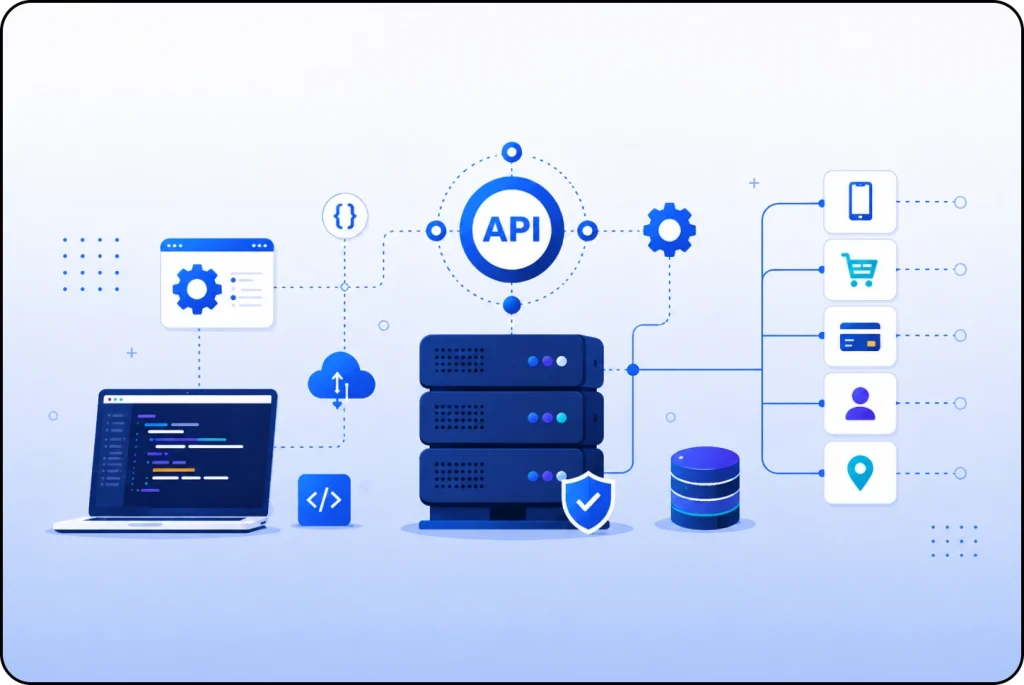
Backend development with API integrations connects your website with tools like payment gateways, CRM, accounting, ERP and booking systems. This automates tasks, reduces manual work and improves the user experience.
Your website is doing more than just showing information. Behind every online order, booking request, payment, or customer access is a backend system that strategises the data and navigates the entire process correctly.
With these integrations, backend development better automates the sharing of more than one software systems. Instead of entering information manually, your systems work together in real time, saving time, reducing errors, and supporting the growth of your business.
What is Backend Development?
Backend development is the foundation of the server side of a website or software. It handles record processing, user authentication, databases, protection, and business enterprise logic, so the whole thing works efficiently on the backend.

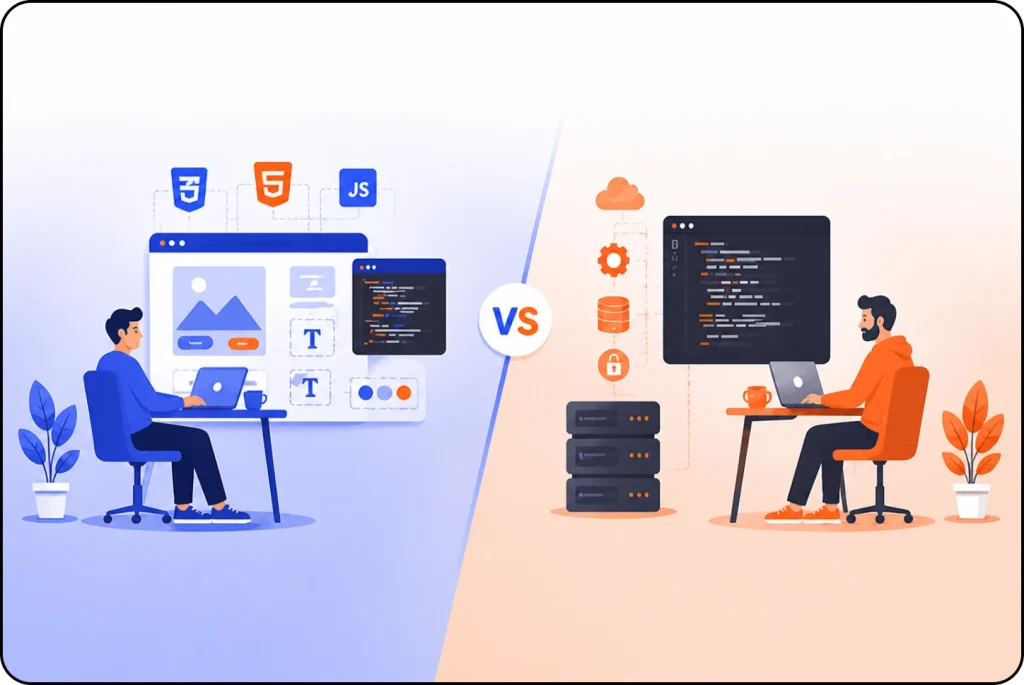
Unlike the front end, which users can see, the back end works in the background. Every time someone logs in, submits a contact form, makes an appointment, or books an appointment, the backend performs a query.
A backend developer builds and maintains this infrastructure on the server side to ensure that websites continue to be stable, reliable, and fast.
Backend development includes:
- Database management
- Server configuration
- User authentication
- Business logic
- Security
- Performance optimization
- API development
- Third party integrations
Without a strong backend, even a beautiful website cannot function well.
What is API Integration?
An API integration connects two or more software applications so they can exchange data automatically. It removes the need for manual data entry and keeps information synchronized across multiple systems.
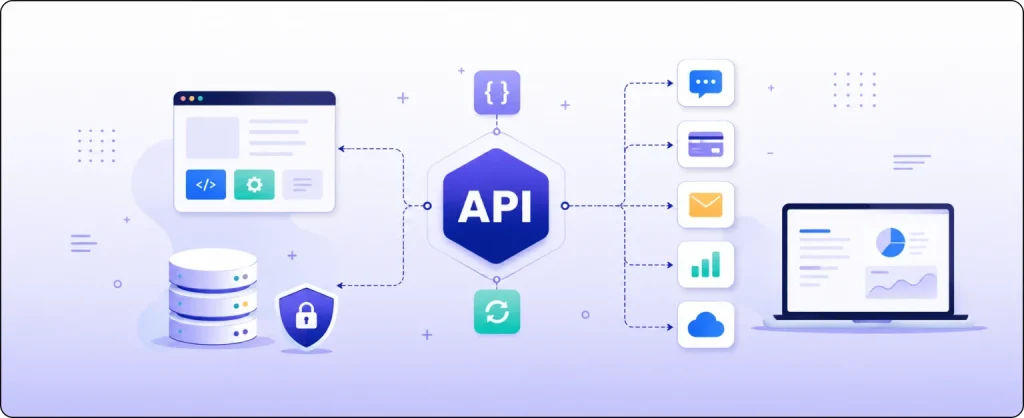
API stands for Application Programming Interface.
Think of an API as a messenger between different applications.
For example:
A customer places an order on your website.
The API can instantly:
- Process the payment
- Update your inventory
- Create an invoice
- Add the customer to your CRM
- Send an order confirmation email
All of this happens within seconds without anyone entering the information manually.
How Do Backend Development and API Integrations Work Together?
Backend development creates the server side system, while APIs connect that system with external applications. Together, they automate workflows, improve data accuracy and make business operations more efficient.
Here’s a simple workflow:
- A customer submits a form.
- The backend validates the information.
- An API sends the data to your CRM.
- Another API creates an invoice.
- A payment gateway processes the payment.
- The customer receives a confirmation email.
- Inventory updates automatically.
Instead of employees repeating these tasks manually, everything happens automatically. This reduces delays and helps businesses serve customers faster.
Common API Integrations for Norwegian Businesses
Norwegian businesses usually connect their websites with payment providers, accounting software, CRM platforms, booking systems, shipping services and ERP software. These integrations save time and improve daily operations.
Business Need | API Integration Example |
Online payments | Stripe, Vipps, Klarna |
Accounting | Tripletex, Fiken, PowerOffice GO |
CRM | HubSpot, Salesforce |
Booking | Calendly, Microsoft Bookings |
Email marketing | Mailchimp, ActiveCampaign |
ERP | Microsoft Dynamics 365 |
Shipping | Bring, PostNord |
Communication | Microsoft Teams, Slack |
These API integrations help businesses avoid duplicate work while keeping data accurate across every platform.
Benefits of Backend Development with API Integrations
Backend development with API integrations improves efficiency, security and scalability. It helps businesses automate repetitive tasks, reduce errors and connect multiple systems into one smooth workflow.
Saves Time
Automation removes repetitive manual tasks. Employees can focus on customers instead of copying data between systems.
Reduce Human Errors
Manual data entry often leads to mistakes. API integrations keep information consistent across every platform.
Improve Customer Experience
Customers receive faster responses. Orders, payments, bookings and confirmations happen almost instantly.
Increase Security
Professional backend systems include:
- Authentication
- Encryption
- Secure APIs
- Access control
- Data validation
These features help protect sensitive customer information.
Supports Business Growth
As your business grows, your backend can handle more users, transactions and connected applications without affecting performance.
Types of API Integration
API integrations come in different types depending on how your business shares data. Some APIs connect your website to external services, while others allow your own systems to communicate internally.
Choosing the right type improves performance, security and flexibility.
1. REST APIs
REST (Representational State Transfer) is the most common API architecture used today. It is lightweight, fast and works well for web and mobile applications. Most modern platforms support REST APIs because they are easy to build and maintain.
REST APIs are ideal for payment gateways, CRM integrations, booking systems, mobile apps and eCommerce websites.
2. SOAP APIs
SOAP (Simple Object Access Protocol) is an older API standard. It offers strict security and structured messaging, making it suitable for industries with high compliance requirements.
SOAP APIs are usually used in banking, healthcare, government systems and enterprise software.
3. GraphQL APIs
GraphQL allows applications to request only the data they need. This reduces unnecessary data transfers and improves loading speed, especially for mobile apps and complex platforms.
GraphQL works well for SaaS platforms, mobile applications, dashboards and custom web applications.
4. Webhook Integration
Unlike standard APIs, which require regular requests to send data automatically when an event happens. For example:
A customer places an order. The website instantly sends order details to your accounting software and your team receives a notification immediately. Webhooks make automation faster and reduce unnecessary API requests.
Backend Technologies
Choosing the right backend technology depends on your business goals, project size and future growth.
Some popular backend technologies include:
- Node.js
- PHP
- Python
- Laravel
- ASP.NET
- Java
Common databases are:
- MySQL
- PostgreSQL
- MongoDB
- Microsoft SQL Server
The right technology depends on your project requirements, expected traffic and integration needs.
The Role of AI in API Integration
Artificial intelligence (AI) makes API integration smarter and more efficient for Norwegian companies. AI can automate record processing, detect anomalies, anticipate machine problems, and improve selection through exploration of shared data between related applications
AI-powered APIs additionally improve customer service using smart chatbots, customised advice, workflow automation, and allow real-time insights.
Signs Your Business Needs Backend Development
If your team spends too much time on manual tasks or your systems do not communicate with each other, it may be time to invest in backend development and API integrations. Here are the common signs:
- Employees copy data between different systems.
- Customer information appears in multiple places.
- Online orders require manual processing.
- Reports take hours to prepare.
- Customers experience delays.
- Your website becomes slower as traffic grows.
- Security concerns continue to increase.
- Existing software cannot scale with your business.
Addressing these issues can improve productivity and reduce operating costs.
What Mistakes Should You Avoid?
Many backend issues happen because businesses focus on getting a project live quickly instead of building it for long term success.
Avoiding these common mistakes can improve security, performance and scalability while reducing future maintenance costs.
Some of the most common mistakes include:
- Selecting the most efficient technology based on lowest costs instead of business needs.
- Ignoring security measures that include authentication, encryption, and access control.
- Building APIs without clear documentation will make tricky updates extra difficult.
- Not designing the backend to deal with future business growth and larger site visitors.
- Skipping thorough testing before deployment.
- Use of framework or software libraries with known security risks.
- Lack of monitoring of API overall performance, errors, and post-launch downtime.
- Integrating too many unnecessary third-party service offers that can blunt performance and increase security risks.
- Poor database design affecting speed and scalability.
- No regular backups or disaster recovery plans.
Partnering with skilled backend developers makes it easier to avoid these mistakes from the start. A well planned backend with consistent API integrations is less difficult to maintain, plays better, and supports your business as it grows.
Best Practices for Secure API Integrations
Secure API integrations protect customers’ data and keep your business systems safe from unauthorized access. Following best practices reduces security risks and improves long term reliability.
Follow these best practices:
- Use HTTPS for all API communication.
- Authenticate every API request.
- Encrypt sensitive data.
- Limit user permissions based on roles.
- Validate all incoming data.
- Monitor API activity regularly.
- Keep API keys secure.
- Update software and dependencies frequently.
- Test integrations before deployment.
- Create regular backups
Security should be part of every stage of backend development, not an afterthought.
Closing Thoughts
Backend development with API integrations is the foundation of modern digital businesses. It keeps your website secure, connects your essential business systems and automates everyday tasks that would otherwise require manual work.
Whether you need a custom backend, API integrations or a complete web application, investing in the right solution helps your business operate more efficiently and prepares you for future growth. With the right technology partner, you can build a secure,scalable and best performing digital platform that supports your business for years to come.
Why Choose Nettsidedesign for Backend Development with API Integrations?
Nettsidedesign.no builds secure, scalable and custom backend solutions for businesses in Norway. We develop reliable APIs, connect your existing software and create systems that improve efficiency, security and long term business growth.
We provide backend development services such as:
- Built from the ground up by Backend
- API setup and integration
- Backend systems for business use
- CRM ready backend development
- Web or app admin panel
- Backend for secure data storage
- Move your backend system to the cloud
- Custom connections between tools
Your business deserves more than a website that looks good. It needs a backend that keeps everything running well behind the scenes.
Our developers build solutions that are specific to your workflows instead of forcing your business to adapt to generic software. Contact us to get started.
Key Takeaways
- Backend development powers everything behind your website.
- API integrations allow different software systems to communicate automatically.
- Automation reduces manual work and human errors.
- Secure backend systems protect customer and business data.
- Custom backend solutions scale as your business grows.
- API integrations improve efficiency and customer experience.
- Modern technologies support faster and more reliable applications.
- Poor planning and testing reduce future development costs.
- Professional backend development improves long term business performance.
- Choosing an experienced development partner helps ensure reliable results.